Picking a countertop in the Phoenix area is not the same as picking one in a mild climate. Your kitchen deals with hot cookware, mineral-heavy water and long afternoons of low sun, and every material handles those differently. This guide compares quartz, granite, butcher block and laminate the way we see them hold up in West Valley homes, so you can match the surface to your remodel. If you already have a shortlist, you can talk with a West Valley kitchen remodel contractor at Skinner & Son and request a consultation before you commit to a slab.
What Arizona Conditions Ask of Kitchen Countertops
Four pressures separate a countertop that looks good in a showroom from one that still looks good in year ten. We judge every material below against the same list.
- Heat. Your range, oven and cookware put hot metal on the surface, sometimes without a thought.
- Hard water. Minerals at the sink leave white film, spots and rings around the faucet.
- Sun. West-facing windows throw hard, low light across the counter for hours each summer afternoon.
- Daily cutting and wear. Knives, pans, grit and dragged appliances scratch whatever you install.
Most kitchen countertop options for Arizona homes handle two or three of these well, but none is perfect at all four, so the real question is which weakness you can live with.
Quartz vs Granite Countertops in Arizona
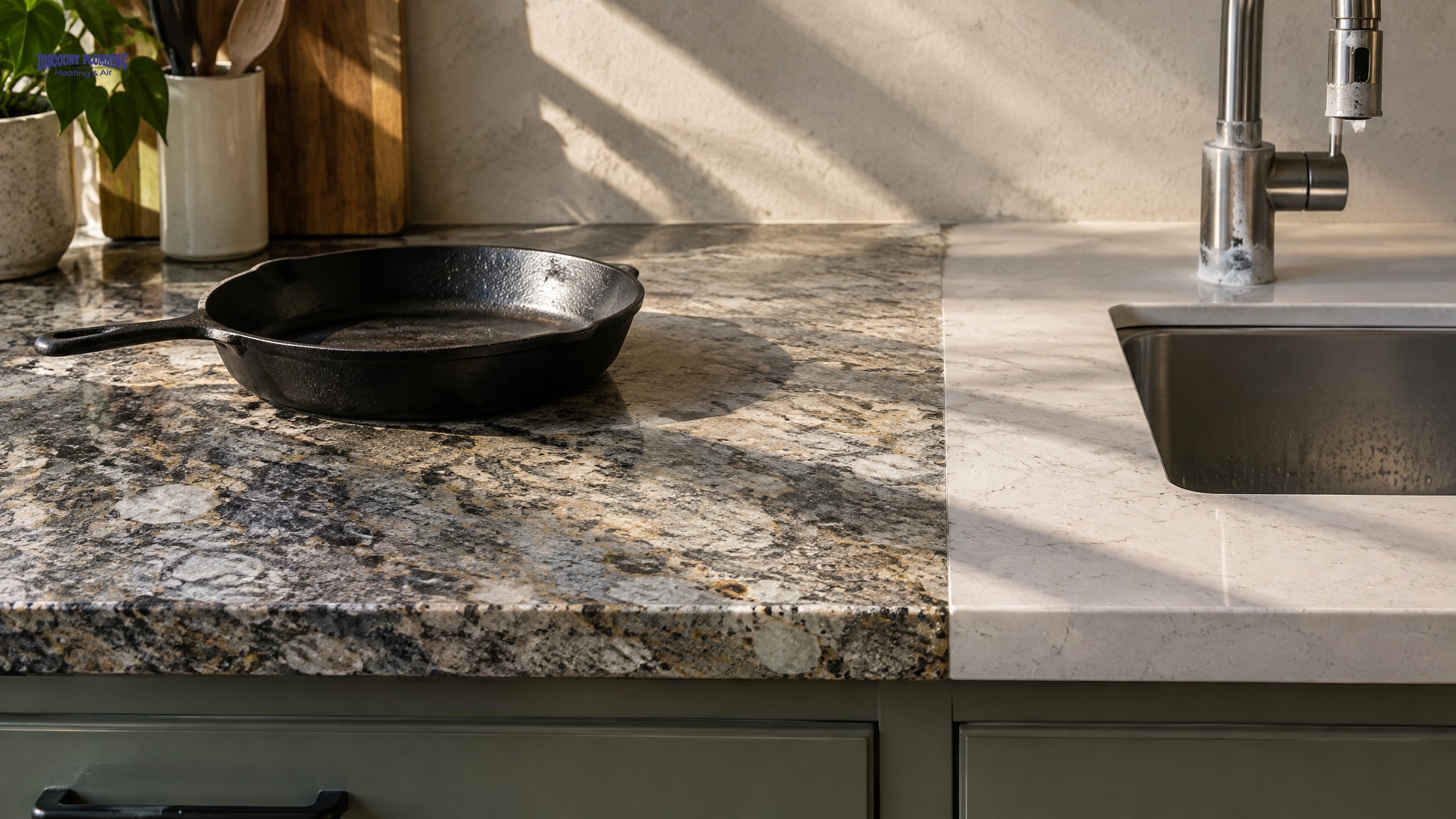
The quartz vs granite decision comes down to heat and to how you choose the slab. Quartz is engineered, so one slab looks very much like the next, and the sample you hold in your hand is a reliable preview. Granite is quarried, so each slab has its own veining, color shifts and mineral flecks.
That difference matters when you shop. Go to the yard and look at the full slab, not a sample chip, because a four-inch square cannot show you a dark vein running through the section that will sit beside your sink. With granite you are choosing a specific piece of stone, and where the fabricator cuts it decides how the pattern flows across the island and where the seams land.
Quartz Countertops in Arizona Heat
Quartz is non-porous, so it never needs sealing, and that is a real advantage in a house with hard water. The catch is the resin that binds the stone particles together. A hot pan set straight from the burner can scorch or dull the surface, and the damage does not buff out.
Treat trivets as part of the care plan from day one. We tell homeowners to keep one by the range and use it every time, no exceptions. Quartz is also not the surface for you if you cook hard and fast and will not break the habit of setting pans down wherever there is room.
Granite Countertops: Heat Tolerance and Slab Choice
Granite handles direct cookware heat well, which is why many serious cooks still ask for it. It is natural stone, so a hot pot is far less likely to leave a mark than on a resin-bound surface. Even so, we still recommend a trivet, because sudden temperature swings are hard on any stone.
Granite needs sealing, and your fabricator should give you written instructions for it. On either material, the seams and the sink cutout are where installer skill shows. A sloppy cutout or a seam placed across a high-traffic spot will bother you for years, so ask where the seams go before fabrication starts.
Hard Water and Sun: Which Kitchen Countertop Options Hold Up Best
Hard water and west-facing sun are the two problems Phoenix-area homeowners notice first, usually within the first summer. Here is how the four materials rank on each.
Best Countertops for Hard Water
Quartz is the lowest-maintenance answer to mineral film. It needs no sealing, and a damp cloth and a mild cleaner take care of most spotting around the faucet.
Sealed granite is a strong second. It resists water well as long as the seal is intact, so you need a re-sealing routine, and your fabricator or the stone's care sheet will tell you the interval. Stick to pH-neutral cleaners on stone, because acidic products such as vinegar sprays and some descalers can etch the surface and wear down the sealer. That is the mistake we see most often with hard-water homes: the owner scrubs harder with the wrong product and makes the dull patch worse.
Laminate wipes clean on its face, but water finds its way into seams and edges near the sink. Butcher block ranks last for the sink area, because standing water and mineral deposits darken wood and it needs regular oil to resist them.
Sun Through West-Facing Windows
Direct sun is hardest on the materials with the most organic content. Wood dries out and can darken or check along the edges, laminate can fade, and resin in quartz can yellow or shift under long, intense exposure. Granite, being stone, is generally the steadiest in a sunny kitchen. Manufacturer care sheets are the authority here, so read the one for your exact product and confirm its guidance on direct sun before you order.
Picture a butcher block run beside a sink under a west-facing window. Over one hot summer the owner sees the surface go dry and pale in the sun, then dark near the faucet, with fine cracks starting along the edge. Window film, blinds or a different finish would have changed that outcome, and so would moving the sink off that wall.
A few practical fixes help on any material:
- Add UV-blocking window film to the west-facing glass.
- Use blinds or shades during late-afternoon hours.
- Plan the sink and cooktop layout around where late-day sun actually lands.
Those fixes cost little compared with a countertop swap, and they are easiest to plan before the layout is set.
Butcher Block and Laminate: Where They Fit in an Arizona Kitchen
Butcher block and laminate both have a place, but neither belongs at the sink run or the range. The sink run takes constant water and mineral exposure, and the range zone takes heat that wood and laminate handle poorly, so keep both materials away from those two spots.
Butcher Block: Warm Accent, Regular Oiling
Butcher block works well as an island or prep-area accent, where it sits away from the faucet and the burners. It suits a homeowner who likes the warmth of wood and will actually oil it on a schedule, because a block left dry in this climate shows it fast. Use it for chopping and baking prep, and set a stone or quartz surface where the water and heat are.
It is not a good fit if you want a surface you never think about.
Laminate suits a short-term refresh. If you are updating a kitchen you plan to redo later, or you need a budget-neutral stopgap while a bigger project is on hold, it does the job. Accept its limits up front: it tolerates heat poorly, and its seams are visible and can let moisture in over time.
Kitchen Countertop Materials Comparison for Arizona Homes
This side-by-side shows how the four materials stack up against the same desert list.
| Quartz | Granite | Butcher block | Laminate | |
|---|---|---|---|---|
| Range heat | Resin can scorch or dull; use trivets | Handles cookware heat well | Scorches and marks | Poor; burns and bubbles |
| Hard water | Best; no sealing | Strong when sealed | Weak; darkens and spots | Fine on face, seams vulnerable |
| Window sun | Can yellow over long exposure | Steadiest | Dries and darkens | Can fade |
| Durability | High | High | Dents and scratches, can be sanded | Lower; chips and peels |
| Upkeep | Wipe clean, no sealing | Periodic re-sealing | Regular oiling | Wipe clean, protect seams |
| Install lead time | Set by slab supply and fabricator calendar | Set by slab supply and fabricator calendar | Shorter; no slab fabrication | Usually shortest |
| Remodel fit | Full remodel built to last | Full remodel built to last | Island or prep accent | Light refresh |
Solid surface is the common alternative homeowners ask about. It is a solid-colored acrylic or polyester material whose seams can be fused so they nearly disappear, and scratches or burns can be sanded out in place, which is something quartz and granite cannot offer. The trade-off is heat: it is less forgiving than either stone, so trivets matter even more. It also scratches more easily, and it does not have the natural depth of granite or the uniform hardness of quartz. If seamless joints and easy repairs matter more to you than stone's toughness, it deserves a look.
Countertop Replacement During a Kitchen Remodel: Lead Times and Fit
The countertop is one step in a fixed order. Cabinets are set and final-measured first. Then comes templating, fabrication and install, and the faucet and backsplash go in last.
That order is the reason you cannot rush the stone. The template is taken from the finished cabinet run, so if the cabinets move, everything after them moves. If you want the broader picture of the trades around the counters, here is how a kitchen remodel unfolds in West Valley homes.
Granite Countertop Installation in Phoenix: What Sets the Timeline
Slab availability and the fabricator's calendar usually set the timeline more than the material does. If the slab you chose is in stock and the shop has an opening, the process moves along. If either one is missing, you wait, whichever stone you picked.
For granite countertop installation in Phoenix, that means choosing the slab early, ideally while the cabinets are still being built. Ordering late is the most common way a finished kitchen ends up sitting without counters. Butcher block and laminate skip the slab step, so they tend to move faster.
Which Countertop Fits Which Remodel
Match the material to the scope of the job:
- Full remodel meant to last: quartz or granite, chosen for how you cook and how much upkeep you will accept.
- Island or prep accent: butcher block, placed away from water and heat.
- Light refresh: laminate, if you are keeping the existing layout and the limits on heat and seams are acceptable.
- Water-damaged kitchen: if a leak has soaked the base cabinets, the countertop becomes part of the restoration scope. Choose the material when the cabinets are rebuilt, not before.
That last case is where having one contractor for both remodeling and restoration helps, because the same crew handles the drying, the cabinet rebuild and the new surface. If you are still deciding how much to change, weigh cabinet refacing or a full kitchen remodel first, since keeping the cabinets limits how much the counter can change. It also helps to think about whole-house versus room-by-room remodeling so the kitchen fits the rest of your plan.
What to Verify With Your Countertop Installer in the West Valley
Before you sign anything, get clear answers on these points, because they are where kitchen countertop installs go wrong:
- When templating happens relative to cabinet installation.
- How seams and sink cutouts will be laid out, and where they land.
- What written care and sealing instructions come with the stone.
- Who handles any cabinet or subfloor problem found during install.
Those answers tell you more about an installer than a showroom does, and our guide on how to choose a home remodeling contractor in Arizona covers the wider hiring questions.
If you are in Avondale, Goodyear, Glendale, Phoenix, Buckeye or Litchfield Park, request a consultation with Skinner & Son and we will visit your kitchen, look at the windows, the sink and the range, and scope the countertop as part of your remodel.
Frequently asked questions
Is solid surface or quartz better for an Arizona kitchen?
For most busy kitchens, quartz is the tougher choice because it resists scratches and tolerates more heat than solid surface. Solid surface wins if you want nearly invisible seams and the ability to sand out scratches or burns in place. If you cook hard and want little maintenance, lean quartz.
What are the key differences between solid surface and granite countertops?
Granite is natural stone with a one-of-a-kind pattern, handles cookware heat well, and needs periodic sealing. Solid surface is a manufactured acrylic or polyester material with fusable seams and repairable scratches, but it is softer and less forgiving of hot pans. Choose granite for heat and character, solid surface for seamless joints and easy repairs.
Which countertop material is most popular for kitchens in the West Valley?
Quartz and granite are the two we install and are asked about most for full remodels, because both are durable and hold up to daily use. Quartz appeals to owners who want low upkeep and a uniform look, and granite to those who want a specific natural slab. Butcher block and laminate are more often chosen as accents or short-term refreshes.
Do I need to reseal granite in Arizona?
Yes, granite needs sealing and periodic re-sealing, and hard water makes keeping the seal intact more important. Your fabricator's written care sheet gives the interval for your specific stone. Use pH-neutral cleaners, since acidic products wear the sealer down.
Can I choose a countertop before the cabinets are installed?
You should choose the material and slab early, but the stone cannot be cut until the cabinets are set and final-measured. Templating comes from the finished cabinet run. Picking the slab while the cabinets are being built keeps the fabricator's calendar from delaying the kitchen.