
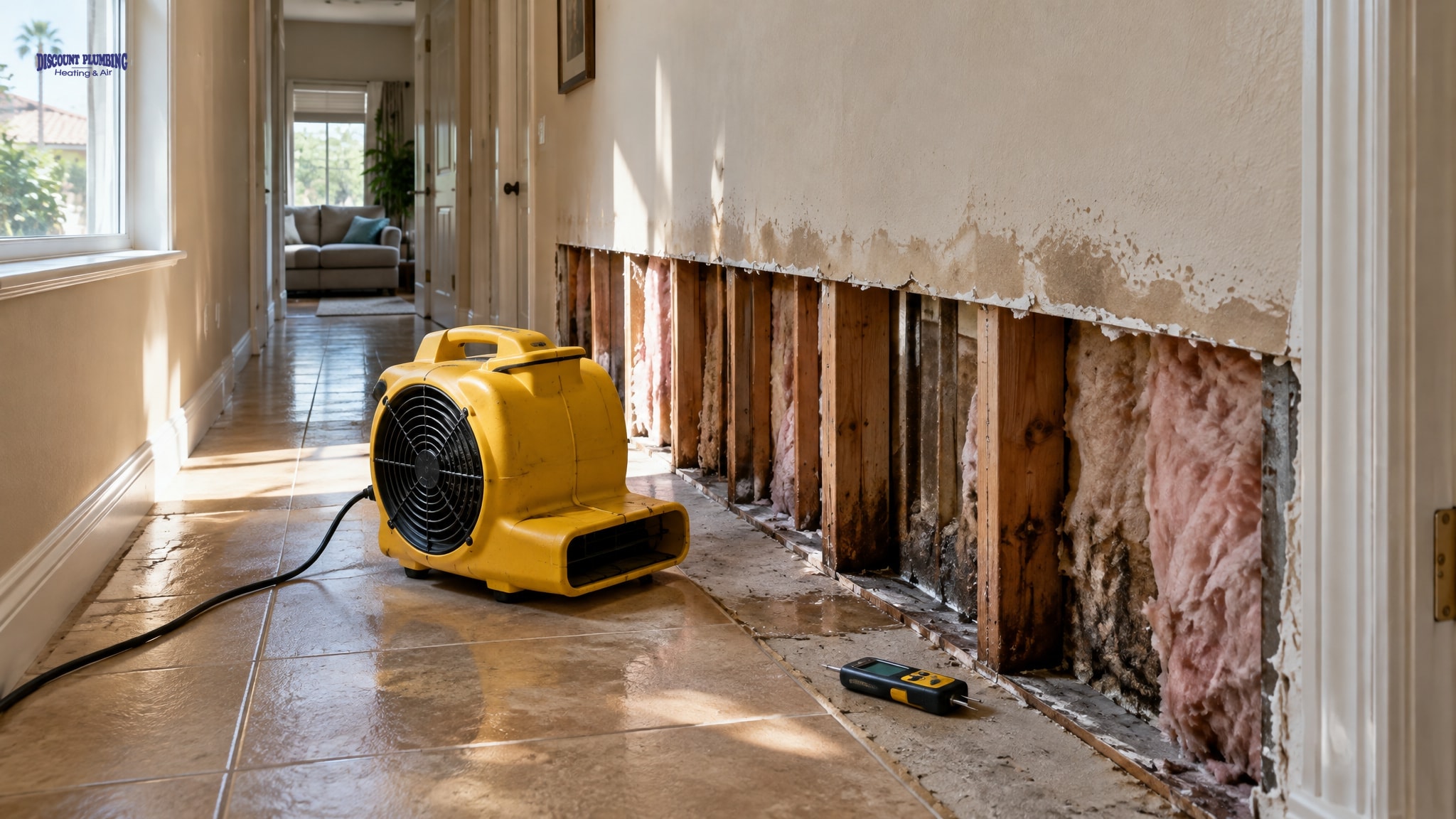
A pipe lets go on a Tuesday night, or a monsoon storm pushes water under a door, and suddenly you need water damage restoration near Glendale more than you need anything else. Skinner & Son is based in Avondale and serves Glendale homes across the West Valley. The company handles the emergency water work and the rebuild afterward, so you deal with one contractor from the first phone call to the final coat of paint.
This guide walks through what happens, in order, so you know what to expect when you call.
Water damage restoration in Glendale: why response speed matters
Water does most of its harm in the first hours. It moves from the surface into drywall, baseboards, subfloor and the cavities behind cabinets, and the deeper it goes, the more material has to come out instead of drying in place.
Speed is really a sequence of steps, and each one has to happen quickly. You call and describe what you see. The company dispatches a crew. The crew arrives, finds the wet areas and takes the first moisture readings. Only after those readings does anyone decide what to remove, where to put equipment and how long drying will take.
Skinner & Son works from Avondale, and Glendale sits within the same West Valley service area. Our page on water damage restoration in Avondale shows where the crew works from, and the broader write-up on emergency water damage restoration in the West Valley covers how emergency calls are handled across the area.
One limit worth stating: no honest contractor can promise an exact arrival time before knowing where the crew is, what else is happening that night and how traffic looks, so ask for an estimated arrival when you call.
After-hours calls and what to expect on arrival
Leaks do not wait for business hours, so call the moment you find water, including nights, weekends and holidays. Ask whoever answers when a crew can be at your door, and plan around that answer.
When the crew arrives, expect questions before equipment. They will ask where the water started, how long it ran and what it touched. Then they walk the house with a moisture meter, checking beyond the area you can see.
That first walkthrough is the most useful thing a crew does. It turns "I think it's just the hallway" into a measured picture of what is actually wet.
Burst pipe and flood cleanup in Glendale: what the job includes
Most calls from Glendale homeowners trace back to a short list of causes. Burst or failed pipes are the obvious one. Water heaters that leak or fail, supply hoses on washing machines, dishwashers and refrigerator ice makers, and monsoon storm water coming in through doors, windows or the roof account for much of the rest.
Each starts differently, but the first job is the same: find where the water went and get it out. A slow hose leak inside a wall can soak a surprising amount of drywall before anyone sees a stain, while a failed water heater can put standing water across a whole utility room in minutes.
The bigger split is clean water versus contaminated water. A broken supply line releases clean water, and many materials can be dried and saved. Flood water from a storm, or sewage from a backed-up line, carries bacteria and debris. That water is handled differently: crews wear more protective gear, and porous materials such as carpet, padding and drywall that the water has touched are usually removed rather than dried.
If you are searching for burst pipe repair in Glendale, note that this section covers the restoration side: pulling the water out, drying the structure and rebuilding what the water damaged. Tell the person on the phone exactly what you saw, including any smell or discoloration, because that helps the crew decide how to prepare.
What happens in the first 24 hours after water damage
The first day has two halves: what you do before help arrives and what the crew does once it gets there. Neither needs a fixed clock time, and neither should be rushed past the safety checks.
Before the crew arrives: safety and first steps
Stop the source if you can do it safely. That usually means closing the shutoff valve for the fixture, or the main valve for the house if the leak is serious.
Power is the next concern. Because water and electricity are a dangerous mix, shut off the breaker at the panel only if you can reach it without standing in water. If you cannot, stay out and tell the dispatcher so.
Before you move anything, photograph it. Wide shots of each room, close-ups of the wet materials and the damaged belongings, and a shot of the source if it is visible. Once furniture is shifted and towels are down, you cannot recreate the original scene.
Our guide on what to do when a pipe bursts goes through these steps in more detail.
On arrival: assessment, moisture mapping and the written plan
Water rarely stays where it lands. Picture a supply line under the kitchen sink that lets go while the household is out. The water runs under the cabinet toe-kick and into the subfloor before anyone sees a wet spot on the floor, so the first visit has to find moisture well beyond what is visible.
That is why the crew maps moisture instead of eyeballing it. Meter readings across walls, floors and subfloor show which areas are wet, which are damp and which are fine, and those readings become the baseline for everything that follows.
The assessment ends with a written plan: what gets extracted, what gets removed, where equipment goes and what the crew will check as drying proceeds. You should see that plan in writing and be able to ask about any line of it.
Water extraction and drying in Glendale homes
Extraction and drying are two separate stages, and the order matters. Skipping ahead, or trying to do both at once, is how homes end up with damp walls weeks after a "cleanup."
Emergency water removal: getting standing water out first
Standing water comes out first because it keeps feeding the damage. Left in place, it wicks up into drywall, soaks into flooring and settles into wall cavities, and drying equipment working against a flooded floor is mostly wasted effort.
Water extraction in Glendale homes typically means pulling the standing water out with pumps and extractors, then removing anything that cannot be saved. Once the bulk of the water is gone, what remains is moisture held inside materials, and that is a drying problem.
If you have water standing in the house right now, emergency water removal is the call to make before anything else.
Drying, monitoring and preventing mold growth
Restoration crews judge drying by moisture readings, not by how a room feels. A floor can feel dry to the touch while the subfloor beneath it is still holding water.
So readings are taken across walls, floors and subfloor, then tracked over the following visits until materials reach a dry reference. That reference is the signal that rebuilding can safely start. The equipment stays until the numbers say it can go, and a room that "feels done" does not change that.
Mold is the reason this matters. It takes hold in damp materials, so the longer wet drywall or padding sits, the more likely it is to become a problem. Fast removal and measured drying both cut that risk, though neither can promise that mold will never appear. For signs to watch after the job, read our guide to mold after water damage.
Insurance paperwork after water damage: what to keep and what the team can supply
If you file a claim, you will be asked to show what happened, what it affected and what was done about it. The more of that you have on paper from the first day, the less you have to reconstruct later.
Skinner & Son documents its work, but it does not decide claims. Whether an insurer approves, partially pays or denies a loss is the insurer's call, and no restoration company can promise otherwise.
Documents that support your claim
Four kinds of paperwork usually matter:
- Photos. The ones you took before anything was moved, plus any the crew takes during assessment.
- A written scope of work. It lists what is being removed, dried and repaired.
- Drying logs. Daily moisture readings show the water was dealt with and when materials reached dry.
- Emergency invoices. Keep every one, including for work done in the first hours.
Take a typical case. A homeowner photographs the damage first, keeps the invoices and asks for the scope and the drying logs. When the adjuster visits, that homeowner has far less to piece together from memory.
Ask the restoration team which of these documents it will give you, and ask early, because the logs are easiest to get as drying goes on. For a clear picture of who handles what in a claim, see restoration company versus insurance adjuster.
From drying to rebuild: one contractor for water damage repair in Glendale
Once the structure is dry, the damage is not over. Drywall may be cut out, flooring pulled and cabinets opened up, and somebody has to put it all back.
Many homeowners find themselves starting a fresh search at that point, collecting new bids and explaining the whole loss again to a stranger. Water damage repair in Glendale does not have to work that way.
Why one contractor for drying and rebuilding saves a second search
Skinner & Son handles water-damage mitigation and reconstruction, along with kitchen and bathroom remodeling. The same company that dries your home also rebuilds it, so the moisture logs and the scope of work carry straight into the repair plan.
You do not have to re-explain what was wet, what was removed or where the water came from. The company already has the readings, the photos and the plan. That also leaves one phone number and one company to hold to the schedule.
You can read more about this approach in our piece on one contractor for restoration and remodeling.
This arrangement is for homeowners who want a single point of contact. It will not suit someone who already has their own builder lined up, and nothing says you must use the same company for both stages.
What a typical rebuild covers: drywall, flooring, cabinets and paint
A rebuild follows what the water took out. Typical work includes:
- Replacing removed drywall, then finishing and texturing to match.
- New flooring or subfloor repair where water got underneath.
- Cabinets repaired or replaced, especially after kitchen and bathroom leaks.
- Paint on the new and surrounding surfaces so repairs blend in.
The exact list depends on your home and what the assessment found. Confirm the rebuild scope in writing before work starts.
Some homeowners find that, with the walls open and the cabinets out, a repair turns into an upgrade. If that sounds like you, book a remodeling consultation and the rebuild can be planned with the finished kitchen or bath in mind. Skinner & Son serves homeowners across the West Valley, not only Goodyear.
Choosing a water damage restoration company in Glendale
A few checks will tell you most of what you need. Look for a company with a real local presence, one that can reach Glendale without a long haul. Ask what its after-hours availability actually is, and get the answer in plain terms. Expect a written scope of work before the job begins, and ask which documentation, such as drying logs and invoices, you will receive for your claim. Finally, find out whether the same company can rebuild, since that decides whether you start a second search.
Our checklist of what to look for in a restoration company goes into each point further.
If water is in your home now, call Skinner & Son right away for water removal. While you are on the phone, ask about a consultation for the rebuild too, so the drying and the repairs are planned as one job.
Frequently asked questions
Does Glendale, Arizona have a water problem?
For homeowners, the water problems that lead to restoration calls are burst pipes, failed water heaters, leaking appliance hoses and monsoon storm water. Any of them can soak drywall and subfloor before you see a stain. Because the damage is often hidden, a moisture check matters even when the visible wet area looks small.
How do I choose a water damage restoration company?
Check for local presence, a clear answer on after-hours availability, a written scope of work, documentation you can hand to an insurer, and whether the company can also rebuild. A company that covers all five saves you a second search once the drying is finished.
Should I wait for my insurance adjuster before calling a restoration company?
No. Water keeps spreading while you wait, and stopping that is part of what you are expected to do. Photograph the damage before anything is moved, call for water removal, and keep every invoice. The adjuster decides the claim, and the restoration team documents the work.
How long does drying take after water extraction?
There is no fixed number, because it depends on how far the water spread and what the materials are. The crew tracks moisture readings across walls, floors and subfloor until they reach a dry reference. Rebuilding starts after that, not before.